Teaching period: December 7-14, 2026
Location: Vilnius Academy of Arts, Panemunė Castle, Lithuania
Teacher(s): assoc. prof. dr. Marius Daraškevičius, architect (Vilnius Academy of Arts), honorary prof. dr. Fritz Barth, architect BDA (Bauhaus-Universität Weimar), Friedrich Barth, M.Sc. Architect (Barth & Barth).
ECTS: 3
Number of available places: 10
Level: BA /MA
Requirements: students from Sculpture, Scenography, Sight-specific Art/Monumental Art, Painting, Architecture and Product Design study programmes are invited to join.
Application deadline: 25th of October, 2026.
How to apply: Please send your motivation letter and portfolio (the main artistic field / artistic research, maximum 12 slides, *pdf) to aida.kirkickiene@vda.lt
Course description
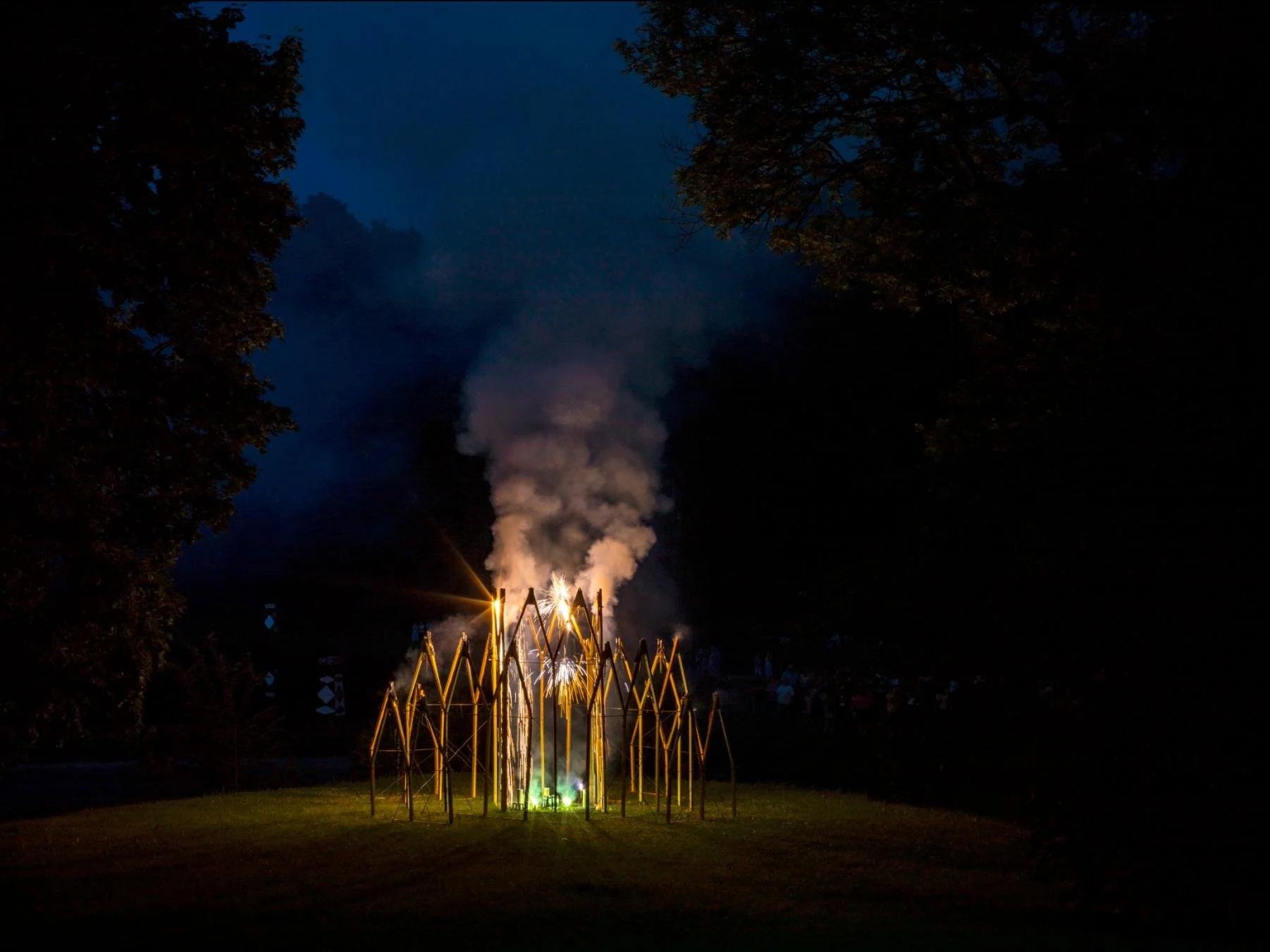
It is a multidisciplinary express course for the KUNO, CIRRUS and NBAA network students. The KUNO Network, CIRRUS Network, and the Nordic Baltic Academy of Architecture (NBAA) invite applications for an interdisciplinary Express Course exploring the theory, pedagogy, and design of fireworks architecture—a historical yet contemporary practice situated at the confluence of architecture, sculpture, and pyrotechnics. Designed for advanced students in Architecture, Sculpture, Scenography, Site-Specific/Monumental Art, Painting, and Product Design, this program investigates the design, material construction, and spatial performance of ephemeral festival structures animated by fire and light.
Background
Historically prominent during the Baroque period, fireworks architecture synthesized structural design and pyrotechnics to transform landscapes into immersive, theatrical environments. Triumphal arches, temporary pavilions, and sculptural stage sets redefined public squares and estate grounds as dynamic arenas of spatial illusion. As contemporary ecological and cultural shifts prompt a re-evaluation of traditional pyrotechnics, this initiative offers a critical framework to re-examine ephemeral architecture as a medium for site-specific discourse on temporality, complexity, and transformation. Building upon the previous iteration’s examination of terrestrial structures, the 2026 course shifts its spatial focus toward aquatic and amphibious conditions, placing optical reflection at the core of its theoretical inquiry. In architectural theory, reflection functions not merely as an optical duplication, but as an active spatial expander. Water alters static geometry into an unstable, fluid plane—effectively doubling the perceived scale of the construct while dissolving the boundaries between physical form, incendiary light, and environment. By designing explicitly for aquatic thresholds, participants will analyze how fluid reflections mediate human perception and heighten the atmospheric resonance of temporary installations.
The program culminates at the Baltic Manor Festival 2027, held at Panemunė Castle, Lithuania. The site's historic water (five ponds around the castle’s hill) features and landscape grounds will serve as an experimental laboratory for an architectural fireworks intervention modeled after early modern station theater. Through this experiential framework, participants will engage with historical precedents to develop contemporary spatial methodologies that interrogate the intersection of architecture, transient materials, and fluid environments.
Pedagogics (Pedagogy)
Reflective ephemeral architecture offers students something rarely possible in their studies: the realization of ideas on a one-to-one scale. Unlike permanent buildings, festive structures are playful, time-bound, and experimental, yet demand rigorous thinking about context, purpose, feasibility, and teamwork. In fireworks architecture, time itself becomes central. Objects must stand as enigmatic works on their own, then transform during the pyrotechnic performance into radiant spectacles, before settling back into altered, memory-laden remains. This sequence of states—before, during, after—invites design approaches closer to music or film than conventional architecture. Participants will be challenged to design for change, rhythm, and transformation, developing strategies that transcend traditional methods.
The Task
Participants will collaboratively design and construct three architectural structures, as well as smaller scattered objects, to serve as platforms for the fireworks display concluding the Baltic Manor Festival on July 3, 2027. Designs must balance aesthetic ambition with technical, financial, legal, and safety considerations. Each structure must function both as a silent, sculptural presence by day and as an integral element of the fireworks choreography by night.
Schedule
The program unfolds in two phases:
Phase 1 (Dec 7–14, 2026, Panemunė Castle, Lithuania): Introduction to fireworks, safety, and design principles. Lectures, workshops, and simulation exercises (Finale 3D) lead to the development of architectural-firework concepts. This call is valid for this phase.
Phase 2 (June 27–July 4, 2027, Panemunė Castle, Lithuania): Construction and assembly of the designs, culminating in the public fireworks performance on July 3.
Full commitment to both phases is required.
Financial support by KUNO:
Travel support between countries: 330 € (except 660 € to/from Iceland)
Subsistence: 250 € per week (5-7 days)
General KUNO Eligibility Rules:
- only BA and MA full-degree students from the KUNO network schools can participate;
-exchange students from other institutions, which do not belong to the KUNO network, studying at one of the KUNO network schools, CANNOT participate;
- full-degree students from the KUNO network schools, currently on exchange at another institution, CANNOT participate (neither with nor without the KUNO grant).
In case of any questions please do not hesitate to contact marius.daraskevicius@vda.lt or
aida.kirkickiene@vda.lt